The native oak species English oak (Quercus robur) and sessile oak (Quercus petraea) shape the character of our mixed forests across Germany. “They make up around ten percent of the total tree population nationwide – in Rhineland‑Palatinate, their share is as high as twenty percent,” explains Professor Hahn. “Oaks are among the most valuable forest trees, both because of the high quality of their wood and because they support an exceptional biodiversity in oak‑dominated habitats. In addition, oaks are better able to cope with climate change than other forest trees due to their comparatively high drought tolerance.”
Finding the resilient oaks
These resilient oaks are therefore a key focus for forestry, which aims to increase their proportion in the long term. Matthias Hahn’s research partner, Dr. Stefan Seegmüller from the Research Institute for Forest Ecology and Forestry (FAWF) in Trippstadt, is developing natural methods for small‑scale forest regeneration. In this approach, young oaks grow in small canopy openings, so‑called “light cones.” This provides them with sufficient solar energy for photosynthesis and allows them to grow optimally. However, mildew can slow down their energy metabolism and thus limit nutrient production.
This challenge was the starting point for the joint research project. The team aims to develop a test procedure for mildew susceptibility and to identify potential resistance mechanisms in oak trees. Previous observations in established regeneration areas had shown that some plants were free of infestation or only slightly damaged. The researchers therefore focused on Erysiphe alphitoides, the powdery mildew species that clearly dominates on oak trees in Germany.
A very special fungus
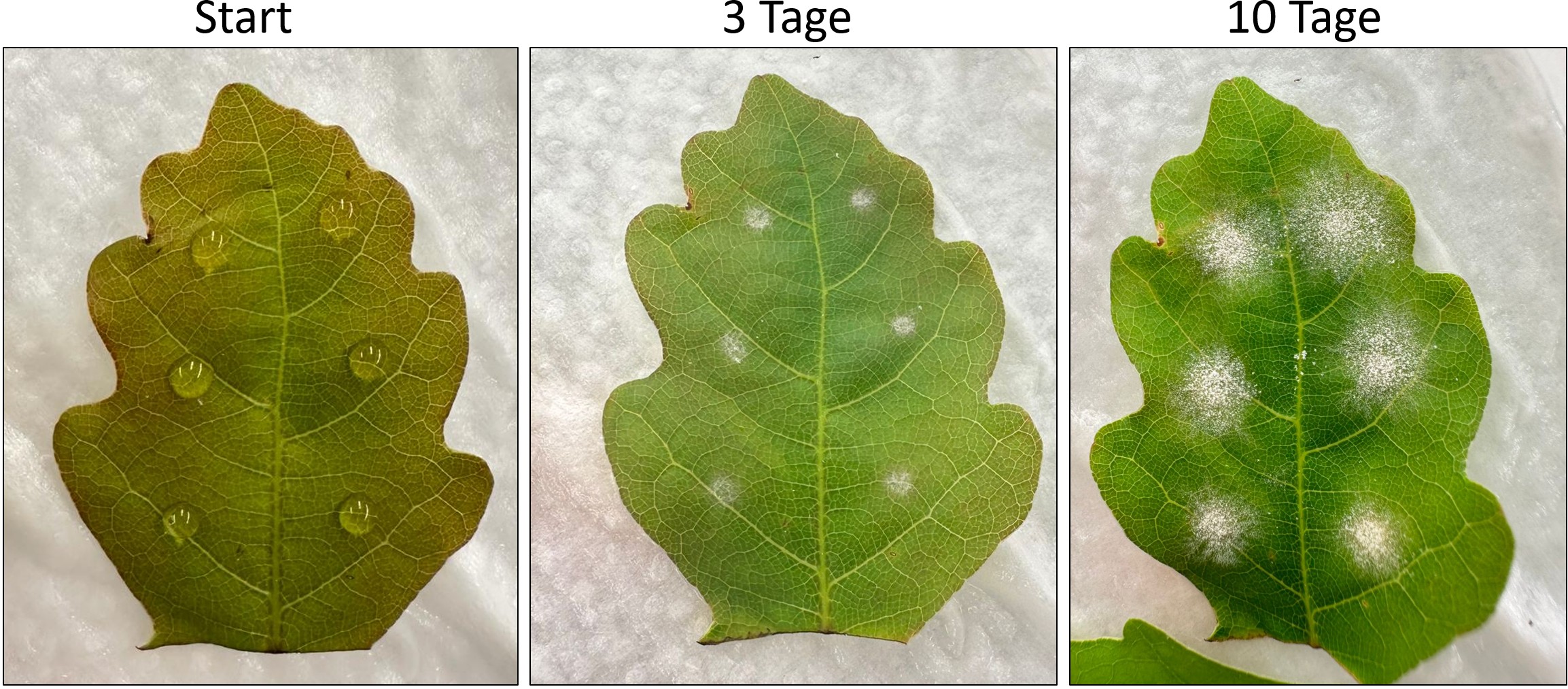
Like most fungi, powdery mildew reproduces via spores. When they land on an oak leaf, they can germinate within a few hours under suitable climatic conditions. The fungus then penetrates the top layer of the leaf and forms haustoria, which are feeding organs that absorb nutrients from living plant cells. On the leaf surface, the visible mycelium, or fungal network, then develops structures for a new generation of spores, which the fungus uses to spread through the air. The infection process can easily be tracked with the naked eye.
To investigate differences in powdery mildew’s infection behavior, the phytopathologist and his research group developed a controlled leaf assay, also known as an inoculation test. “We added powdery mildew spores to healthy, young leaves that had been cut.” This sounds simple, but it is not easy with powdery mildew. Unlike the spores of many other fungal species, powdery mildew spores cannot be preserved and must be collected fresh from the living plant. This means that there is only a narrow time window for collecting spores: in spring, when the delicate epidermis of young oak leaves is still susceptible and can be easily penetrated by the fungus.
A standard for leaf tests
To be able to carry out continuous and reproducible tests, the scientists relied on technical support in the form of climate chambers, which provided optimal conditions for both plant growth and fungal infection. “We regularly washed spores from infected leaf material, counted them under the microscope, and checked their vitality with germination tests,” explains Matthias Hahn. “Only spores confirmed to be viable were applied to the test leaves, drop by drop, in the form of a defined suspension.”
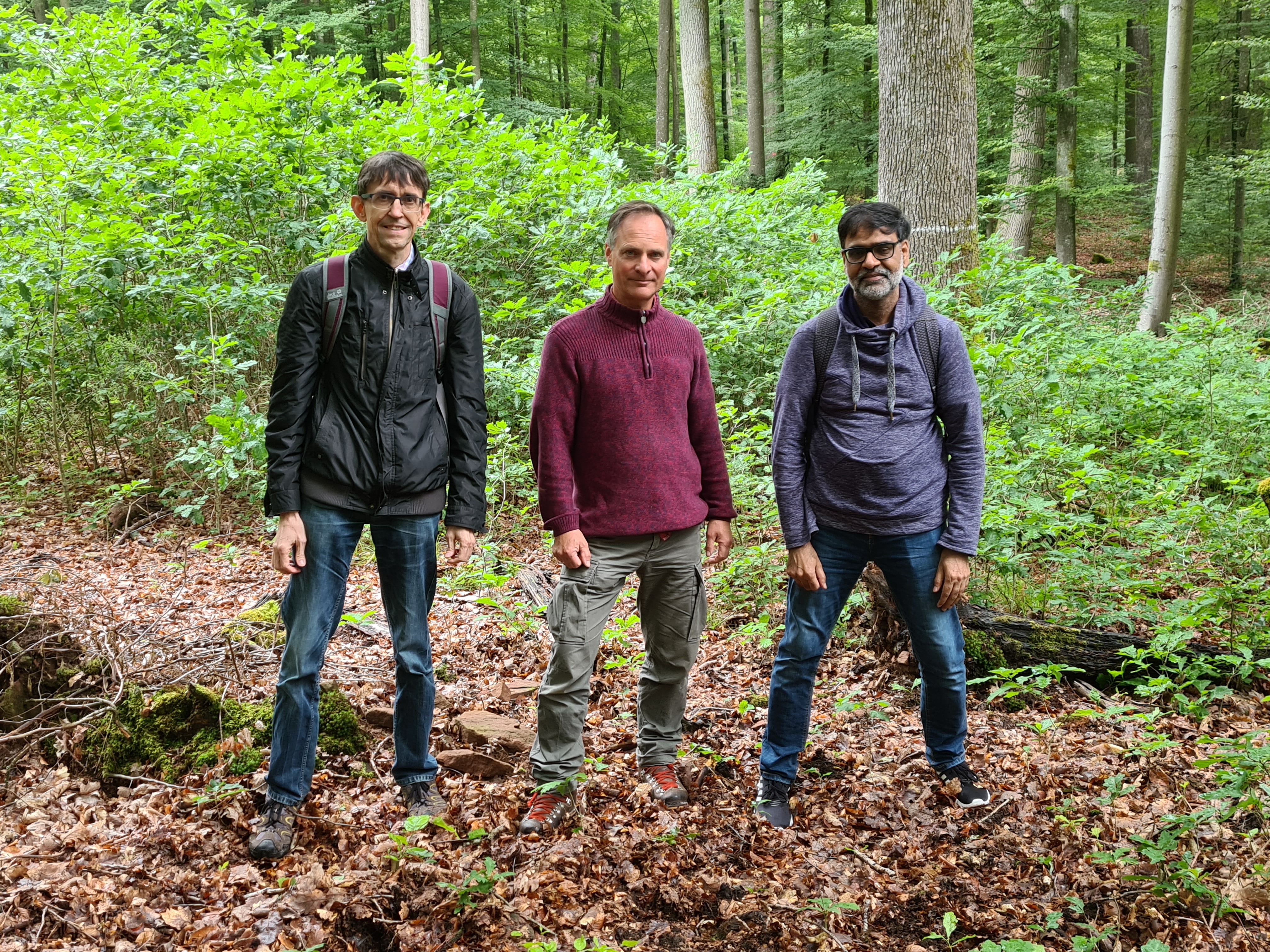
For this work, the scientists made use of a unique genetic resource. Over several years, Stefan Seegmüller had collected acorns from trees in various regions and used them to establish a biodiversity garden at the Antonihof near Trippstadt.
The freshly inoculated leaves were kept in climate chambers under humidity conditions that were optimal for powdery mildew infection. The researchers then monitored the infection process at both microscopic and macroscopic levels. All experimental steps were meticulously documented to ensure full reproducibility of the test procedure.
Rheingrafenstein wins against Heidenkopf
The inoculation tests were carried out on plants from different sites of origin: oaks that had proven predominantly susceptible to powdery mildew in preliminary tests (origin: Heidenkopf, abbreviated HK) and oaks that had shown partial resistance (place of origin: Rheingrafenstein, abbreviated RGS). Leaves from naturally resistant oak species – red oak and Turkey oak – served as controls.
In three independent experiments, mildew colonies produced significantly more conidia on HK oak leaves than on RGS oak leaves. In other words, oaks from the dry Rheingrafenstein site ultimately displayed greater tolerance to infection. These findings confirmed the patterns observed in the earlier field assessments.
However, Matthias Hahn also has some reservations about the inoculation tests: “We can now quantitatively assess mildew susceptibility, and this method is now generally available. However, reaching this point was complex and full of challenges. We needed climate chambers to produce mildew spores continuously. I was also struck by how different oak leaves can look. Some turn green immediately, while others are reddish at first and often deformed. This introduced considerable variation in the test material. In 2024, we also noticed that nature has a mind of its own. We planned to harvest leaves from the outdoor stock at Antonihof, but a late frost in April destroyed all the young foliage. This setback cost us valuable time.”
How are oak trees’ defenses structured?
In addition to the leaf tests, the phytopathologist and his colleagues used RNA sequencing to investigate which genes are activated in oak trees when infected with powdery mildew. RNA is the transcript of genetic information that contains instructions for forming proteins. “We have actually seen that genes are switched on. However, it is unclear whether this activation occurs because the oak is being infected or because it is beginning to defend itself against the invading fungus. One thing is certain: we have found promising molecular markers. In the future, these markers can be used to detect oak responses to powdery mildew infestation even before visible symptoms appear.”
However, when examining the infection processes at a cellular level under a microscope, the scientists observed no signs of defense reactions. “Autofluorescence of leaf cells can be used to detect processes such as the incorporation of hardening substances into cell walls. The more ‘glowing dots,’ the better the defense.” However, the researchers did not observe any dots in native oak trees, even if they were more tolerant of powdery mildew. It seems that the fungus is able to suppress the oak trees’ defenses in this case. In red oak and Turkey oak, which are naturally resistant, the development of the fungus slows down shortly after penetration of the leaf cells, and only rudimentary surface mycelium develops, which no longer produces new spores.
Forest research in times of climate change
Forests in a changing climate are an exciting and challenging topic for phytopathologists. “In this project, we have contributed a small piece of the puzzle to the management of powdery mildew in oak trees. But more broadly, we are still at the beginning of understanding how forests will respond to the rapidly evolving pressures of climate change – it is a Herculean task that requires much more long‑term thinking and sustained commitment than we currently have.”

© RPTU, Thomas Koziel
Prof. Dr.
Matthias
Hahn
Professor for Plant Pathology
"Fungi are incredibly diverse organisms with astonishing, useful, and harmful abilities, and the research of them is extremely fascinating and exciting."
Matthias Hahn obtained his diploma in Biology at the University of Munich, and his PhD in Microbiology at the ETH Zurich, in 1987. He worked as a Postdoc at ETH Zurich, Stanford University, MPI for Plant Breeding Research Cologne, and University of Constance. Since 2000, he is Professor for Plant Pathology at the RPTU University Kaiserslautern-Landau. His research interests are the mechanisms of infection and fungicide resistance of plant pathogenic fungi, in particular the grey mould fungus Botrytis.
FORSCHERPROFIL AUF RPTU.DE
FURTHER READING ON PLANT-PATHOGENIC FUNGI:
Leisen T, Bietz F, Werner J, Wegner A, Schaffrath U, Scheuring D, Willmund F, Mosbach A, Scalliet G, Hahn M (2020): CRISPR/Cas with ribonucleoprotein complexes and transiently selected telomere vectors allows highly efficient marker-free and multiple genome editing in Botrytis cinerea. PLOS Pathogens 16(8)
Rupp S, Plesken C, Rumsey S, Dowling M, Schnabel G, Weber RWS, Hahn M (2017): Botrytis fragariae, a new species causing gray mold on strawberries, shows high frequencies 1 of specific and efflux-based fungicide resistance. Appl. Environ. Microbiol. Vol. 83, No. 9
Hahn M (2014): The rising threat of fungicide resistance in plant pathogenic fungi: Botrytis as a case study. J. Chem. Biol. 28, 133-141