The building sector is one of the largest consumers of resources and accounts for around 40 percent of CO₂ emissions in Europe. For Jürgen Graf, there is therefore no way around thinking consistently in terms of cycles when it comes to construction in the future. He sees wood as a key material for this: “Wood is renewable and therefore conserves resources. It binds CO₂ as long as the components exist. And it can be processed precisely and easily handled using automated methods.”
Timber construction campus shows what is possible
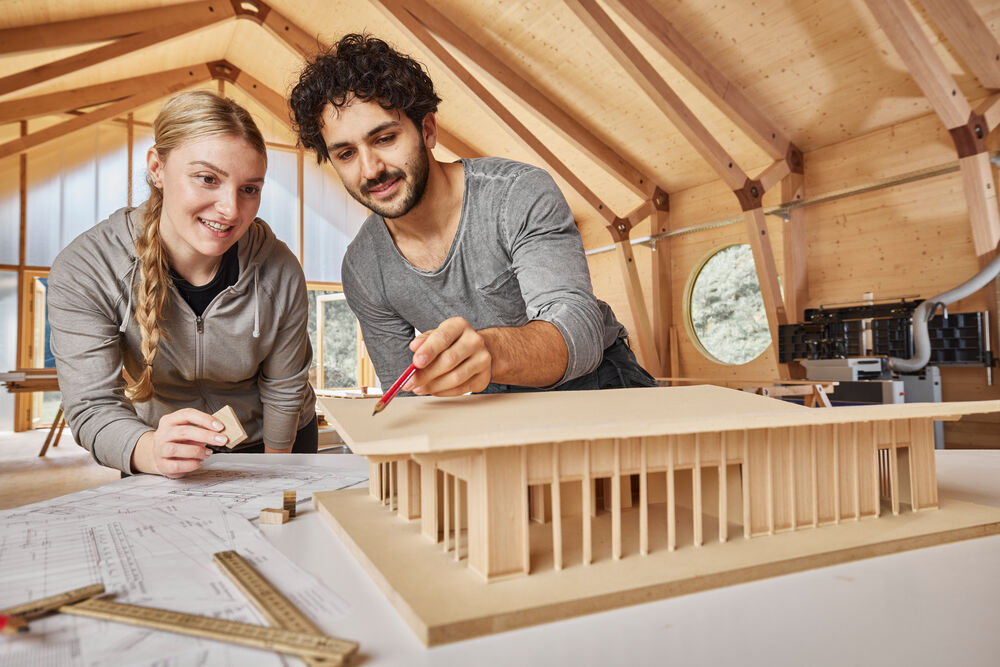
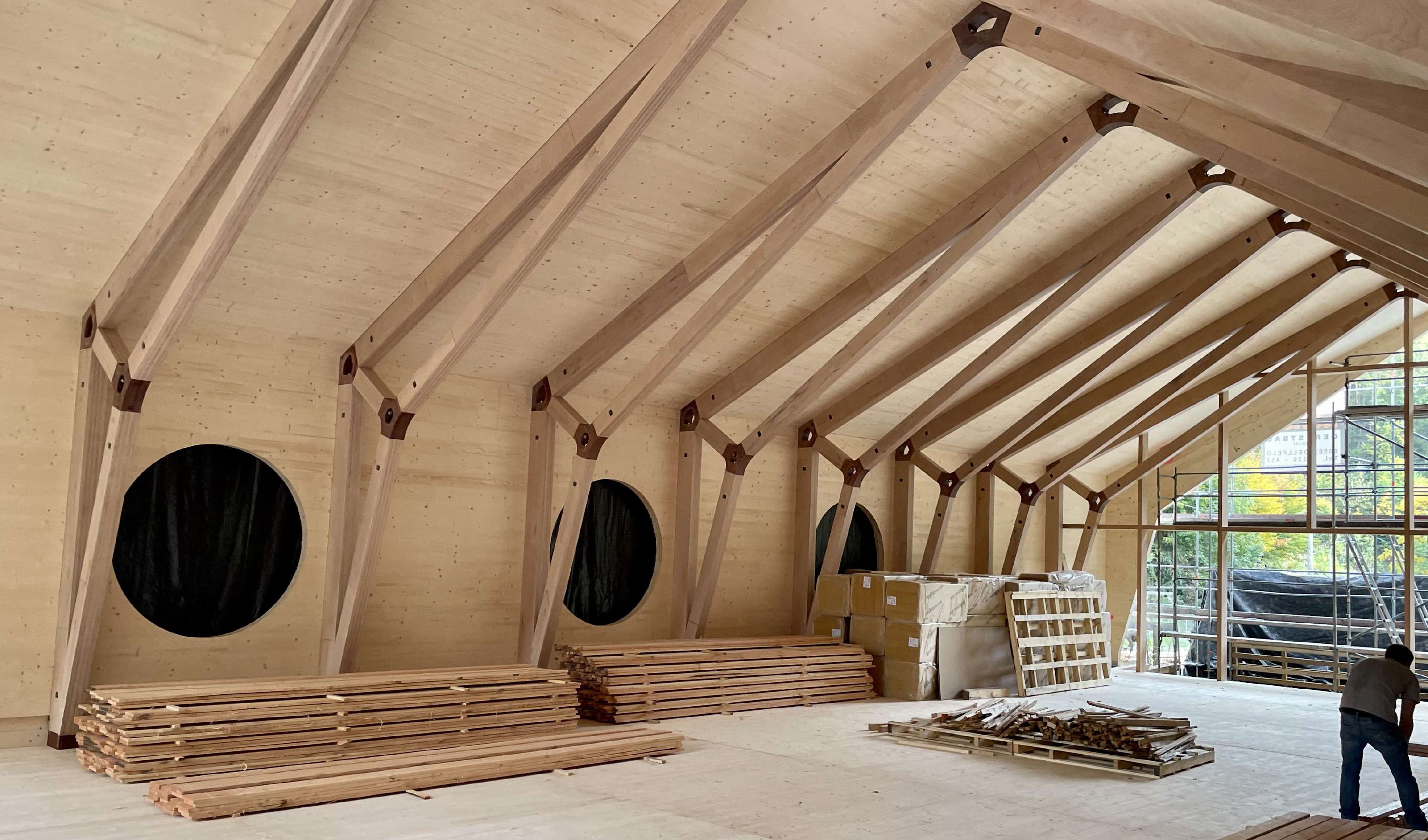
Jürgen Graf and his team and partners are testing how wood can be used in a forward-looking way in the Palatinate Forest. Near Kaiserslautern, on the RPTU's “timber construction campus Diemerstein,” a research and workshop hall made of wood was built, designed and co-constructed by architecture students. The hall can be completely dismantled and reused. The highlight: the supporting structure consists of prefabricated frame elements that are connected by specially developed nodes and cone-shaped dowels made of synthetic resin pressed wood. The nodes and dowels, and thus the individual elements, can be removed without causing any damage.
For Graf, it is an important signal that the project was honored with the German Engineering Award 2024 and that the supporting structure was featured on the cover of the renowned architecture magazine DETAIL and Deutsche Bauzeitschrift. “This shows the high value that circular construction now has among engineers and architects.” The hall not only demonstrates precise craftsmanship in timber construction, clever structural design, and beautiful architecture, but also stands for circular construction as a fundamental principle. In concrete terms, this means planning projects from the outset in such a way that building elements can be easily dismantled, reused, and transferred to new structures at a later date.
Building elements with multiple lives
“Much of what is marketed under the label of circular construction does not live up to the name,” says Graf. “Of course, you can often unscrew a wood screw and remove an OSB board from a square timber. But if we have to search for and sort out lots of small components during demolition in 50 years' time, we have a problem.”
In his opinion, the solution lies in developing building components that can be manufactured and assembled in a standardized way, similar to automotive engineering.
“If we work with a few large elements with clearly defined joints that can be easily detached later, demolition will be straightforward even decades from now. And that is the prerequisite for materials to actually be reused. If the effort involved is too great, it won't happen in practice.”
Graf refers to this as “element-based construction.” In contrast to modular construction, where entire room modules are delivered, this approach relies on prefabricated individual elements such as ceilings, beams, columns, and walls. “If we standardize these elements on a large scale, we create a uniform structural principle that works for different types of buildings, even with different uses,” explains Graf. The façade remains freely configurable. The result is a flexible building system whose components can be easily reused—even in existing buildings—while also allowing for architectural diversity. The fact that this works in practice is demonstrated not only by the hall in Diemerstein, but also by a large shelter in Dillingen, which was built according to the same principle.
Wooden parking garage
For the first time, a large-scale project in an urban area is now about to be implemented: under the project name “Frieda³,” a wooden parking garage is planned for the Dresden Municipal Hospital. The Federal Institute for Research on Building, Urban Affairs, and Spatial Development (BBSR) is supporting the project with €4.2 million as part of the nationwide funding program “Pilot Projects – Innovations in the Building Sector.” The Dresden Municipal Hospital, as the client, applied for funding together with Holzbau Kompetenz Sachsen GmbH and the “t-lab – Wood Architecture and Wood Materials” research department at RPTU. The t-lab will receive an additional €160,000 for scientific support. The design is based on the interdisciplinary research project “Convertible wood hybrid for differentiated stages of construction.” Four universities were involved in the project, which was led and coordinated by wood construction experts at RPTU.
The project marks an important milestone for Graf. “More important than functional buildings such as halls is sustainable construction in urban areas for living and working, i.e., in multi-story buildings. Because that is where the great need lies.”
Sustainable through long-term use
From the outset, the parking garage was designed not only to be completely dismantlable and allow individual elements to be reused, but also to enable flexible use. The rooms are 2.75 meters high instead of the usual 2.10 meters. The building skeleton contains supports that are positioned in such a way that they do not need to be moved for different uses – parking, working, living. “Sustainability also means that something lasts as long as possible,” explains Graf. “If something is flexible in its use, in the best case scenario it doesn't have to be demolished in the first place.”
Planning services must pay off
According to Graf, the funding for Frieda3 roughly covers the additional costs compared to conventional construction methods. "The planning of recyclable buildings is significantly more complex. I have to run through several possible uses in the future to know where my supports can be placed," he explains. In addition, all element joints must be precisely designed and planned in the prefabrication process. Politics and remuneration systems would therefore have to change in such a way that sustainable planning becomes economically viable. Even if this is not yet the case, he is convinced that pilot projects such as Frieda³ mark a turning point: “It shows what is possible!”
Making waste wood fit for reuse
In addition to planning and construction issues, the professor is also looking at how old components can be made fit for reuse, because “everything that has already been manufactured has been consumed; reuse only generates minimal CO2 emissions and no resources.” Research is important because wood is unique: “A steel girder hardly changes. Wood, on the other hand, is sensitive to moisture, it shrinks, swells, cracks, and deforms over time under constant load.” He recently secured some old wooden beams, leftovers from the demolition of a supermarket. The large pile of wood is now waiting in the Diemersteiner Valley for the new semester, in line with the motto “Design and build with what you have!” Students will catalog, examine, and prepare the boards and beams so that they can use them to design and develop recyclable structures. In the end, with the help of the students, a new hall for the timber construction campus Diemerstein will be built as a so-called design-research-build project.

© Sven Paustian, Pirmasens
Prof. Dr.
Jürgen
Graf
Professor for Structure and Material
“What drives me: research on circular economy-oriented construction with wood, development of innovative construction methods amd research in real-world laboratories."
Jürgen Graf is a civil engineer and responsible for teaching “Structural Systems and Materials” to architecture students. His research focuses on engineered timber construction. Since 2014, Graf has served as the research spokesperson for the t-lab Timber Architecture and Wood-Based Materials.
FORSCHERPROFIL AUF RPTU.DE
Want to dive deeper into the topic?
Here are some recommendations for further reading:
DETAIL 1/2.2024: Connections for circularity in wooden buildings
Website of the Department of Architecture at RPTU: t-lab - Workshop and Research Hall Diemerstein
Stricker, E.; Bayer, D.; Graf, J.; Lenherr, B.; Milla, B. (Hrsg.) (2025) Wege zur Bauwende: Klima- und ressourcenschonend konstruieren. Triest Verlag. ISBN 978-3-03863-092-0 (German only)
Graf, J., Hao, B., Birk, S. et al. (2024) Legitimation der kreislaufeffektiven Holzbauweise – Nachweis der Klimarelevanz. Bautechnik 101, S2. 64-73. (German only)