“In construction, we already have good options for testing components from an outside perspective. But until now, we haven't been able to look inside our 'patients' under operating conditions without destroying them,” explains project manager and civil engineer Matthias Pahn. “The large-scale CT scanner makes it possible for the first time to apply loads to real-scale structural building components and simultaneously examine their interior with precision. We can observe live how cracks and damage develop under stress” – much like in medicine, where a computer tomograph provides insights into the human body.
Almost ten meters high, weighing 32 tons
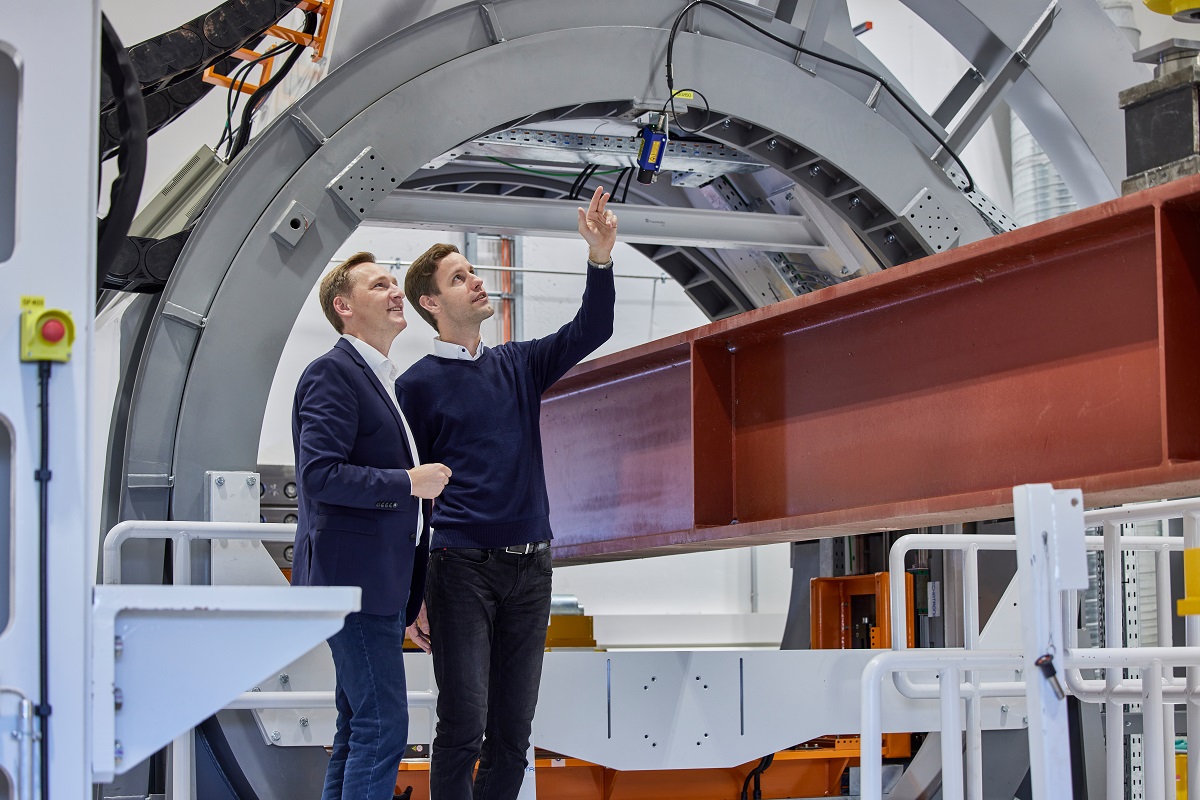
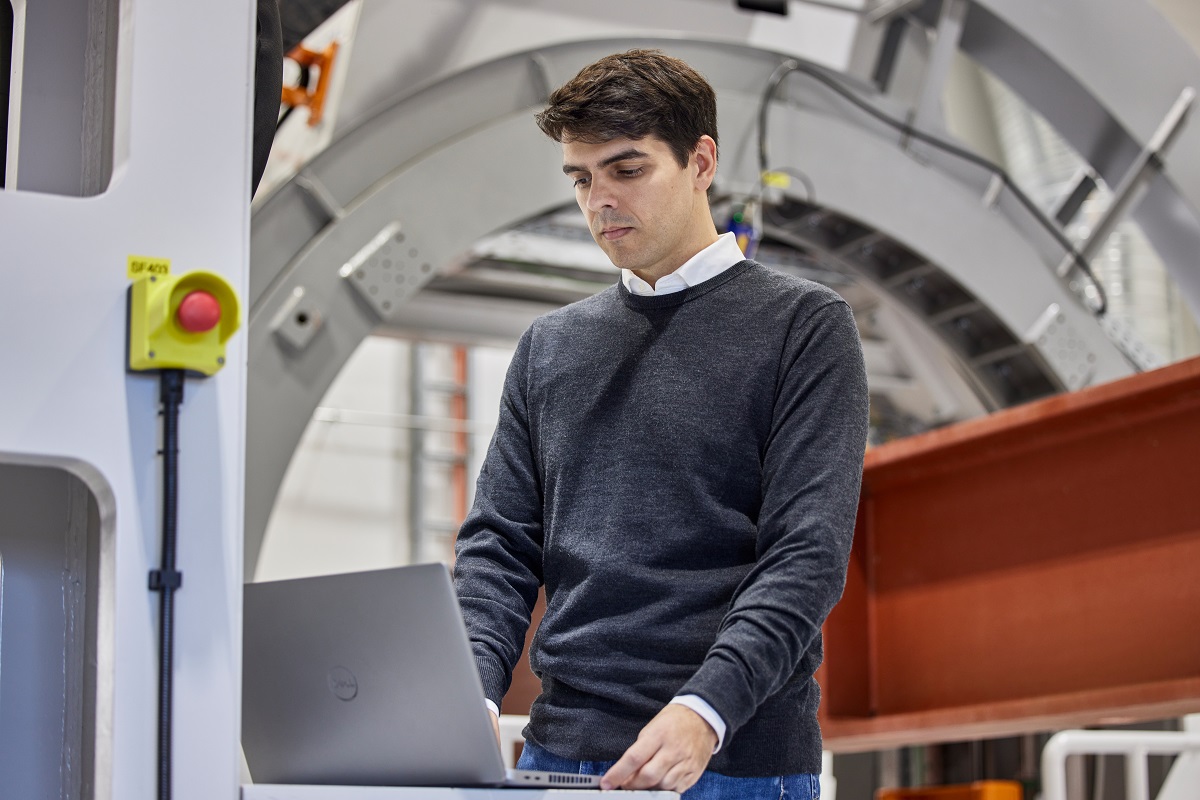
The new research computer tomograph is a colossus almost ten meters high and weighing 32 tons, which takes up most of a specially constructed hall on the RPTU campus. Compared to its small medical siblings, it seems almost grotesquely oversized. However, the design and associated capabilities are similar.
As is familiar from doctors' offices and clinics, a ring-shaped gantry is the central element here as well. In this case, however, the gantry is around ten meters high and incorporates a radiation source that rotates around the patient. Its X-ray energy is impressive: nine megaelectron volts of acceleration voltage supply electrons with so much superpower that they effortlessly penetrate concrete, metals, plastics, and wood. By comparison, technical CTs for material testing work with around 200 kiloelectron volts. Similar to the medical version, there is a table. However, instead of people lying on it, there are meter-long reinforced concrete beams, for example, which can be delivered via a large truck access gate.
Better understanding of the load-bearing behavior of structures
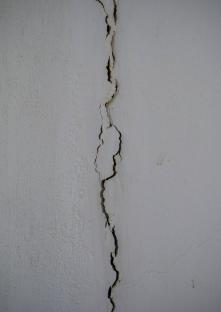
Crane rails allow structural building components of various sizes and dimensions to be positioned and examined in this large-scale CT. Its sophisticated design and loading capabilities enable the application of both vertical and horizontal static forces on the test specimens and, if necessary, even cyclic loads – such as those caused by the continuous vehicles traffic over a bridge. Three high-resolution detectors provide versatile and precise insights into the interior of the components and deliver high-resolution 3D images that reveal even the finest cracks as small as 0.1 millimeters wide.
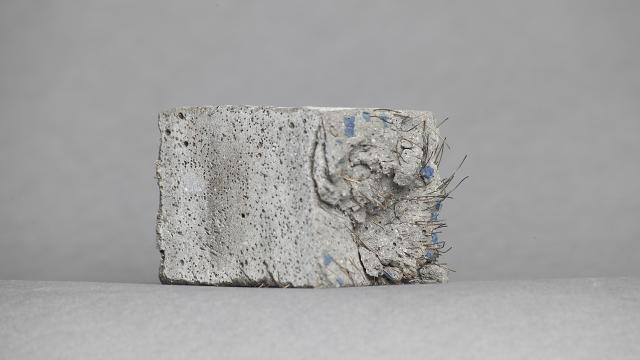
“This globally unique combination of load testing and high-resolution imaging helps us to better understand the load-bearing capacity of structures and thus extend the service life of our infrastructure in the long term,” says Pahn. ”We can also use it to test new, more environmentally friendly building materials and components, such as fiber-reinforced concrete or non-metallic reinforcement, which consume fewer resources and are more durable.”
Climate protection through preservation
After all, every demolition that is avoided saves resources, energy, and emissions. “If we have a better understanding of the condition of components, we can decide whether renovation makes more sense than new construction. This not only saves costs but also emissions. The production of cement, a major component of concrete, is responsible for eight percent of global greenhouse gas emissions. In addition, construction accounts for more than 40 percent of total waste within the European Union. That is why it is important to preserve existing buildings for longer and develop resource-efficient components and construction methods,” explains the civil engineer.
With the new facility, he also wants to investigate how well recycled concrete and used buildings or infrastructure components work for new constructions. This can help keep valuable raw materials in use and strengthen the circular economy in construction. “Concrete is a wonderful material because it is recyclable. In the future, mobile CTs could be used on site at bridges and buildings to check the structural integrity, both in terms of safety and preservation, and to differentiate the recyclability of individual parts before complete demolition.”
New territory for project partners too
More than ten years after the first sketch, the first practical test phase of the facility is now beginning, with around nine million euros in funding. A large part of this comes from the German Research Foundation's (DFG) Large-Scale Instrumentation Initiative, with additional funds from the state of Rhineland-Palatinate for the construction of the radiation protection hall.
RPTU's project partners are the Landesbetrieb Liegenschafts- und Baubetreuung (LBB), a general contractor for the construction of the radiation protection hall, and OHB Digital Connect GmbH from Mainz. This company belonging to OHB SE, which specializes in high-tech solutions for space travel, developed the XXL gantry in collaboration with the Fraunhofer Development Center for X-ray Technology (EZRT) and the Fraunhofer Institute for Industrial Mathematics ITWM.
“This is a unique project for everyone involved, in which we are also testing the limits,” says Pahn. One challenge, for example, is the automated processing of the huge amounts of data generated by the tomography images. ”Doctoral theses are already being written in the Mathematics Department that deal with special evaluation methods for this data – we are really doing pioneering work here!”